
Author: marie

Pratham’s blended approach to supporting school readiness in India

Pratham has been working on the capacity-building of district-level resource groups (trainers) in Maharashtra in the western peninsular region of India on a school readiness campaign to engage parents, particularly mothers, in preparing their children to enter grade one. 

A state-level resource group (SRG) was created which trained district-level resource groups to train schoolteachers on the school readiness campaign. More than 200,000 mothers’ groups were formed during this campaign and supported by schoolteachers through a blended approach which consisted of several components:  

  • “Idea videos” as well as paper-based activity cards, called “idea cards,” with demonstrations and explanations of play-based activities in local languages. 
  • These idea videos are further disseminated to the schoolteachers and shared via WhatsApp messages to mothers’ groups 
  • Mothers meet weekly in groups to watch short video clips with a demonstration of an activity. They receive instructions for the weekly play-based activity, discuss experiences, and give feedback.
  • Upon request, mothers’ groups also receive some practical messages (e.g., simple tutorials) to enhance digital literacy (e.g., how to use YouTube to find information such as a rhyme or songs in local language). 
  • Mothers individually spend at least one hour a week doing an early childhood education play-based activity with their child. 
  • Pratham staff, schoolteachers and volunteers maintain the regular running of the programme by visiting mother groups and providing support via WhatsApp and radio programme broadcasts.

In a second initiative, Pratham supported the Capacity Building of Master Trainers of Himachal Pradesh Pre-Primary Programme (Government and Pratham Partnership initiative) through technical support on content, systems, monitoring, and more. This work continued even through the challenges posed by the Covid-19 pandemic.
How VSO prepared facilitators using the SAMR Model

VSO has been running home-based Early Childhood Education (ECE) centres in the Rohingya camps in Jamtoli, Cox’s Bazar since 2018 and this programme was extended to host communities in 2020.

Most ECE facilitators are mothers and sisters from Rohingya and host communities who do not have any training. VSO worked with MESHGUIDES to develop a course which promotes a play-based ECE approach. After assessing ECE facilitators’ educational background and access to digital devices and their experience of using technology, it was found that none of the facilitators had prior teaching experience. Only 10% of the facilitators had experience of using basic mobile phones. 

On the one hand, ECE facilitators did not have confidence in using play-based teaching methods and needed a lot of support and training, on the other hand, logistically it was challenging for VSO teacher trainers and mentors to visit the camp regularly to deliver face to face training. Therefore, VSO considered an Edtech solution. All ECE facilitators were given a tablet preloaded with videos of songs, stories, and model lessons. 

By applying the SAMR Model, VSO could adapt the teacher training as follows: 

  • Substitution: printed teacher guide on play-based ECE was replaced by a digital version.
  • Augmentation: national volunteers produced a series of videos showing how to make play resources from locally available recycled/reusable materials in local languages so that facilitators could watch videos and follow instructions to make teaching materials.
  • Modification: watching videos from other countries, ECE facilitators identified used bamboo, recycled plastic bottles and scrap fabric to make play resources.

The VSO Schools App in Rwanda

In Rwanda, VSO is testing approaches to blended CPD for Early Childhood Education teachers to improve the use of play-based approaches to ECE. The approach combines digital content provided via the VSO Schools App with Communities of Practice and support from school-based mentors. 

Tablets were purchased to test the approach. In the long term, a web-based version will be available building on the commitment of the Government of Rwanda to supply one laptop per teacher. However, laptops would reduce the opportunities for ‘redefining’ the approach and providing learners with opportunities to experience a ‘unique, novel, constructive learning experience’ for example by easily capturing and sharing photos/videos of learning. 

The VSO Schools App provides digital interactive content for asynchronous self-study on learning through play for ECE teachers. The App allows for the use of text (with audio), photos and videos, quizzes, games and interactive tools such as image pairing and drag and drop exercises. After uploading content, learners can progress through the modules offline. An internet connection is required to upload data on progress to be tracked, and to use the chat function. Content for the App in Rwanda is structured in 13 modules. Also, teachers can upload and share materials and examples which creates opportunities for teacher portfolios.

VSO considered the local context and structural limitations when designing the approach to testing the App in the Rwandan context. The SAMR model was used to assess the added value of the App. It shows the approach represents an ‘augmentation’, as it replaces in-person approaches with an alternative way of learning. It also represents a ‘modification’, as learning outcomes can be improved through interactive and engaging learning experiences. There is also potential for the approach to ‘redefine’ approaches to CPD because of the function in the App for learners to engage in chat rooms and share examples directly through the App or use other Apps installed on the tablet to create a virtual CoP. 

The approach requires strong data management to track learners’ progress through the modules and knowledge acquisition (through pre and post module surveys). The App has an in-built data management function that allows for different levels of (secure) access. Progress tracing can be done in ‘real-time’ although this requires the devices to be frequently connected to the internet. Where connectivity is a challenge, VSO volunteers visit schools to ‘tether’ their tablet to the teachers’ tablet to upload data. 

The BRAC Paracounsellor Model

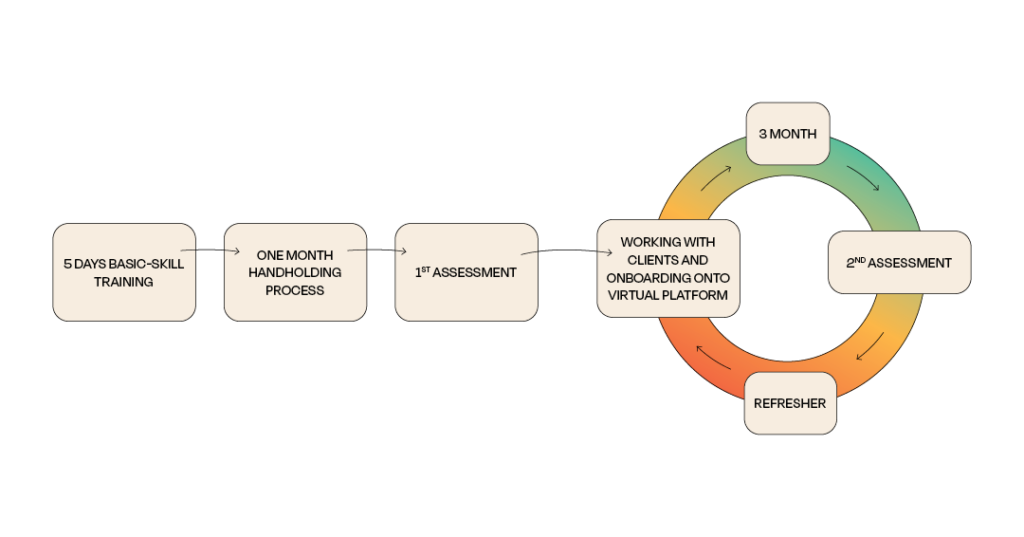
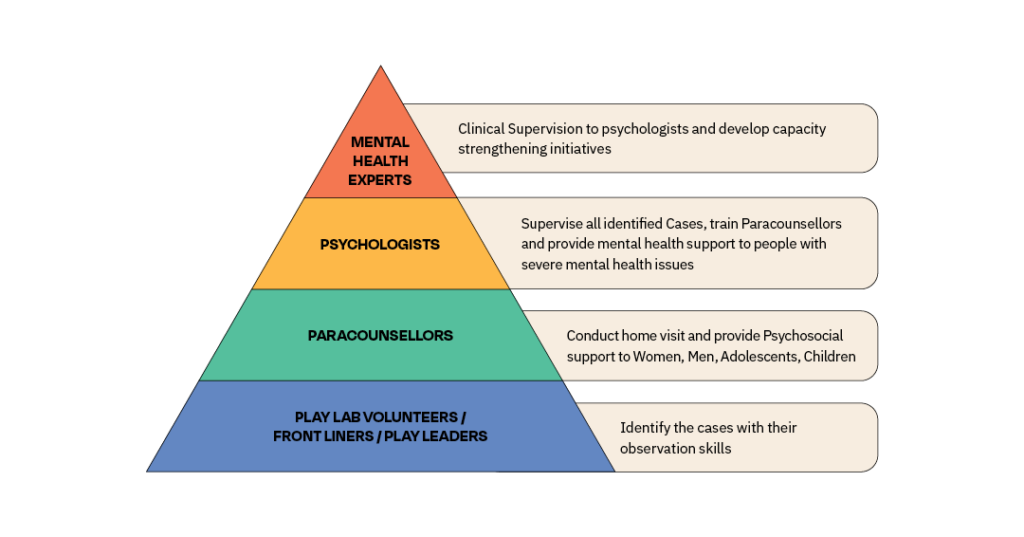
The BRAC Paracounsellor Model is a 4-tier referral pathway to ensure mental health support to beneficiaries. During the COVID-19 pandemic, the model transitioned to a blended modality. The recruitment of paracounsellors, their training, workshops, skill tests, documentation, regular supervision, etc. were moved online. Concurrently, psychosocial services were provided through mobile feature phones as most beneficiaries do not have access to smartphones.

Depending on the availability of resources and/or context, the modality of the training process is determined. The paracounsellors take a 5-day basic skills training programme. Post training, the paracounsellors go through a one-month online handholding process during which they learn from an experienced paracounsellor. After this handholding process, the first assessment of the paracounsellor is conducted. Post assessment, the paracounsellor is permitted to work with beneficiaries and become familiar with the ICT requirements. After three months, the second assessment is conducted. Subsequently, refresher CPD training sessions strengthen the skills of paracounsellors.

Para-counsellor model (online and/or offline) depending on availability of resources/context

Simultaneously, psychologists provide training and supervision to paracounsellors. The blended modality of the skills development process of paracounsellors ensures the model can manoeuvre depending on the availability of resources and context. For instance, effective skills development channels are usually sustained online, but when needed, the concerned psychologist might address the concerns of the paraprofessional in-person. The validated tools used in this model (GHQ-12, PHQ-9, SDQ, KAP, Child Screening tools, etc.) were all adapted to the Bangladeshi and Rohingya cultural context to screen and access the beneficiary’s specific mental health concerns/needs. In addition, fidelity tool(s) are used to assess the competency of the paracounsellor regarding their skills and how proficiently they apply them. Regular monitoring is ensured by uploading all relevant data to a secure and encrypted platform (TAROWORKS). These data are kept confidential. Data security enables different groups – psychologists, monitoring & research team, and software team to coordinate while upholding safeguarding policies.

Training process of paracounsellors depending on the availability of resources/context


How VVOB in South Africa kept participants in the blended CPD trajectory motivated and engaged

Teaching and Learning Foundational Mathematics Through Play for Grade R-3 Educators is a pilot project that targets 1000 Foundation Phase educators from 250 schools across 4 districts in KwaZulu Natal (South Africa). 

The project, implemented by VVOB in South Africa, aims at enhancing educators’ classroom practice in the teaching of foundation phase mathematics by integrating a play-based approach. To achieve this, the project tests the effectiveness of two modalities (synchronous/ blended and asynchronous /remote CPD) for educators’ professional development.

Central to the approach in both synchronous and asynchronous modalities is to build a community of learning. 

Key features are:

Social Learning Platform

A needs assessment was conducted which showed limited exposure to online learning with educators. The decision was made to include the Social Learning Platform (SLP) in the LMS to stimulate content-related engagements among educators for augmented knowledge acquisition and link the course content to classroom practice using Learning through Play (LtP). PLC prompts were integrated into course modules to stimulate and encourage peer learning via the SLP. 

Peer and Community Recognition

In-course and Social Learning Platform motivation is promoted through the “Wall of Fame”, recognition and celebrations for educators that engage meaningfully and share resources and practice. Badges and certificates of completion serve as a motivation.

Weekly WhatsApp prompts 

During the face-to-face orientation sessions, WhatsApp groups of local groups of teachers were established. The groups were aimed at encouraging educators to participate in the course and engage with others via the Social Learning Platform. All prompts focused on directing teachers to the course platform.

Delivery and unpacking of the Mini Toolkit

Each educator received a toolkit with resources and manipulatives for the classroom. To motivate them to use the toolkit, they had to unpack it and perform an activity that aligns with the R-ATPs (Recovery Annual Teaching Plan) for the upcoming term for classroom teaching practice and relevance. Teachers were encouraged by the toolkit to think out of the box and create resources to add to the toolkit.

Reflection sessions 

A face-to-face reflection session was facilitated with the groups in the districts. The following aspects were covered:

LtP course content Q&A drawing on data from online engagements on the Social Learning Page and LMS.

Evaluate if educators have formed PLCs and the composition of those PLCs.

Orientation of PLC Champions. 

A mini toolkit was presented, and an unboxing activity aligned to the R-ATPs (Recovery Annual Teaching Plan) conducted.

Reflection sessions 

A face-to-face reflection session was facilitated with the groups in the districts. The following aspects were covered:

  • LtP course content Q&A drawing on data from online engagements on the Social Learning Page and LMS.
  • Evaluate if educators have formed PLCs and the composition of those PLCs.
  • Orientation of PLC Champions. 
  • A mini toolkit was presented, and an unboxing activity aligned to the R-ATPs (Recovery Annual Teaching Plan) conducted.

For the asynchronous group, an online version of the reflection sessions and virtual unpacking followed the delivery of toolkits to their schools.

Blended Daycare Training: how BRAC IED adapted the CPD system to the learner

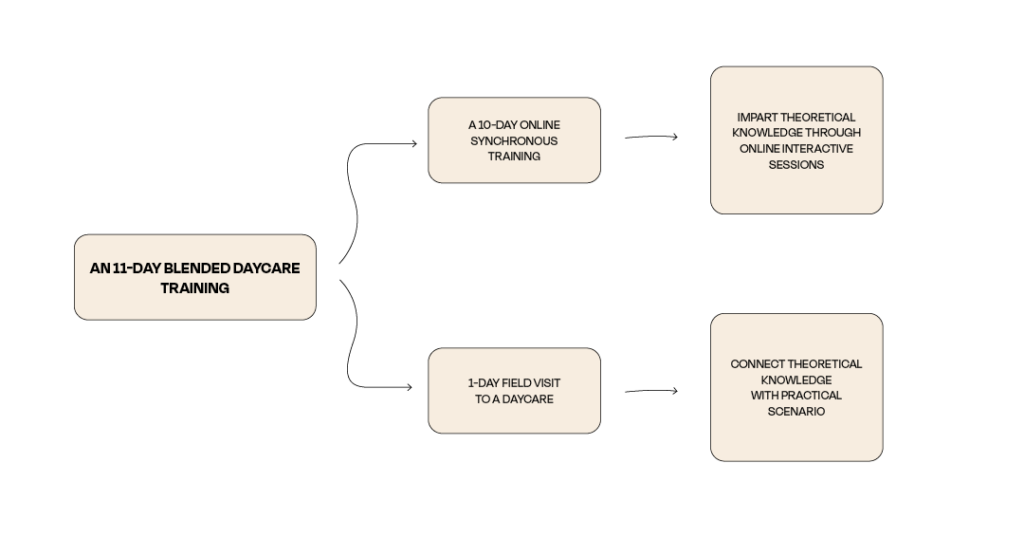
Due to the COVID-19 pandemic, BRAC Institute of Educational Development (BRAC IED) designed and implemented an online daycare training for aspiring women daycare entrepreneurs. Initially, the plan was to move to a face-to-face modality. However, this would significantly increase the training cost (around 60%) and it would not have been feasible for participants from different cities in Bangladesh to attend. Keeping these in mind, a blended CPD approach was considered with the design framework of 10 days of online training (as before) with a one-day field visit (in addition).

10-day synchronous online training

The training introduces the basic concepts of a standard daycare service to enhance participants’ knowledge, skills, and attitudes in the field. The training contents cover subject areas such as ECD, psychosocial support, play-based curriculum, space design, and basic business concepts for daycare facilities among others. An interactive pedagogy is followed to keep participants engaged and make online learning effective (brainstorming, group discussion, group work, etc.). The sessions are held via Zoom.

1-day field visit

In the revised design, a one-day field visit is added. This design change was seen as crucial because online sessions cannot fully incorporate the practical experience crucial for professional development training in daycare. The inclusion of a one-day in-person visit was financially feasible and added a component of face-to-face active learning.

Challenges and mitigation strategies

The participants are diverse in terms of socio-economic background, educational qualification, profession, religion, and ethnicity. There were challenges with limited access to technology, digital literacy level, language barriers, and remote location. Thus, strategies had to be implemented to mitigate these issues.

For communication and information sharing, emails were used. Classes were conducted via Zoom and a Zoom auto attendance record report was used for reference. There were participants who did not know how to use emails or have their own email. In some cases, they were not familiar with Zoom. As a result, class invitations were sent, and email addresses were collected through SMS (zoom link, etc.), and follow-up calls were made to ensure participation and give instructions. Also, a Zoom orientation session was held at the start of the training. Participants were given certificates of completion based on their attendance and participation. Although BRAC IED has a Learning Management System (LMS), for this group, training documents were shared with participants through Google drive. Feedback for evaluation and improvement could be submitted through email and WhatsApp.

Flowchart that depicts an 11-day blended daycare training

Supporting Adolescent Girls’ Education (SAGE) programme: the evolution of a blended CPD model | by Plan International

SAGE is funded through the Foreign, Commonwealth and Development Office’s (FCDO) Girls’ Education Challenge initiative. It is a non-formal education programme in Zimbabwe, delivered through a consortium, led by Plan International in partnership with the Ministry of Primary and Secondary Education (MoPSE). Its aim is to help the most educationally marginalised acquire foundational literacy and numeracy skills. SAGE seeks to promote and improve education for girls by tackling the root causes of gendered social and economic barriers, creating an enabling environment for transforming gender norms. 

SAGE organises its Community Educators into local learning hubs across 11 districts. Hub-based staff are supported by formal schoolteachers who provide ongoing mentoring and CPD. Prior to the pandemic, the CPD model included face-to-face workshops only.

Covid-19 restrictions led to educational closures. The move to WhatsApp training was a realistic pivot due to reliable mobile phone connectivity. WhatsApp enabled the technical team to continue with CPD as Community Educators adapted to facilitating distance learning and to training new volunteers. The use of WhatsApp allowed for continuous dialogue and increased opportunities for reflective practice. 

Initially, WhatsApp training engaged educators through large group work. Feedback from facilitators and Community Educators shaped the approach to move to smaller groups to allow for more in-depth discussions. 

The UK Open University (OU) was part of the SAGE technical team to virtually lead WhatsApp training sessions for facilitators. In some instances, CPD sessions for Community Educators were co-facilitated by the technical team to build confidence. All facilitators attended reflective sessions and gave feedback on the approach. 

Training materials were succinct, accessible, and compatible with smartphone access. Two-hour WhatsApp workshops for facilitators posed key questions grounded in the case studies. Later, the model moved to smaller group training with sessions focussing on ‘Plan, Do, Feedback, Reflect,’ with staff from hubs across districts working as sustainable geographical communities of practice. As Covid-19 restrictions eased, the training model has become a blended CPD model retaining the benefits. 

  • 1
  • 2